The Quiet Thunder of Japanese Single Malt in Five Bottles
Japan doesn’t dramatize whisky so much as it refines it. Where Scotland often celebrates wildness—Atlantic spray, kiln smoke, windswept moors—Japan turns inward, engineering nuance with the same monastic focus it applies to knives, tea, and gardens. Fermentation temperatures are watched like heartbeats. Cut points are argued over like philosophy. Casks are not just containers but collaborators: American oak for clarity, European oak for dusk-colored depth, and—most mythic—Mizunara, Japan’s tempestuous oak that leaks, resists coopers, and, when tamed, writes incense and temple-smoke into the spirit.
If you’re building a cabinet that expresses Japanese single malt at its apex, the following five bottles form a complete arc. You’ll travel from orchard brightness to forest hush, from coal-kiln peat to sherry-soaked velvet, from alpine clarity to mizunara incense. Each is a different verse in the same poem.
Yamazaki 25 Year Old — The Cathedral of Incense
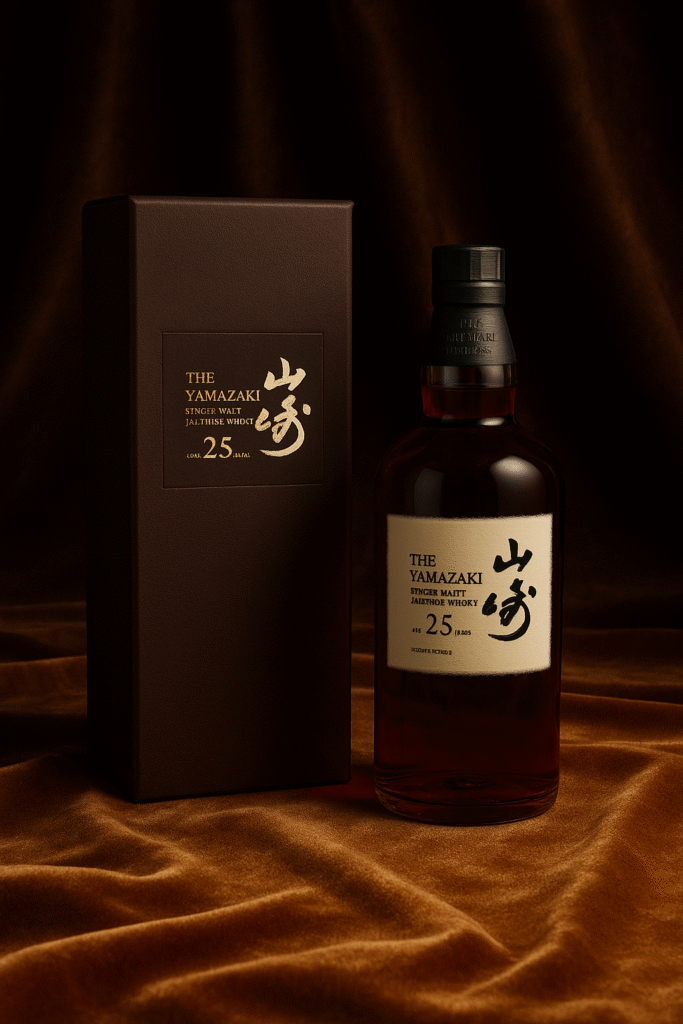
The Yamazaki distillery, founded in 1923 by Shinjiro Torii, is the birthplace of Japanese whisky. Over the decades, it has earned a reputation for creating multi-dimensional spirits that express Japan’s reverence for detail and balance. The Yamazaki 25 Year Old is the grand oration of that philosophy, a liquid bell that tolls deep and resonant with every pour.
In the glass, the whisky unfurls with the patience of age. Aromas of dried fruits, black cherries, lacquered woods, and sandalwood incense rise slowly, as though carried by temple air. On the palate, the European oak sherry casks provide richness—espresso, clove, and black chocolate—while Mizunara contributes its elusive character of coconut, camphor, and Japanese temples. The finish is seemingly endless, a dignified retreat into cocoa and smoke.
What makes the Yamazaki 25 particularly rare is its reliance on long aging in select Spanish oak sherry butts. Every batch is a careful composition, with Suntory’s blending team treating each cask as a note in a score. With stocks vanishingly limited, each release finds itself immediately vaulted into auctions and collections worldwide. For drinkers, it remains the archetype of Japanese depth; for collectors, it is a tangible form of heritage.
To pour Yamazaki 25 is to collapse time. Decades of maturation, hundreds of seasonal shifts, and the hands of artisans all meet in one glass. Few whiskies are more appropriately described as cathedrals—spaces where silence, ritual, and beauty converge.
Hibiki 30 Year Old — Harmony Cast in Crystal
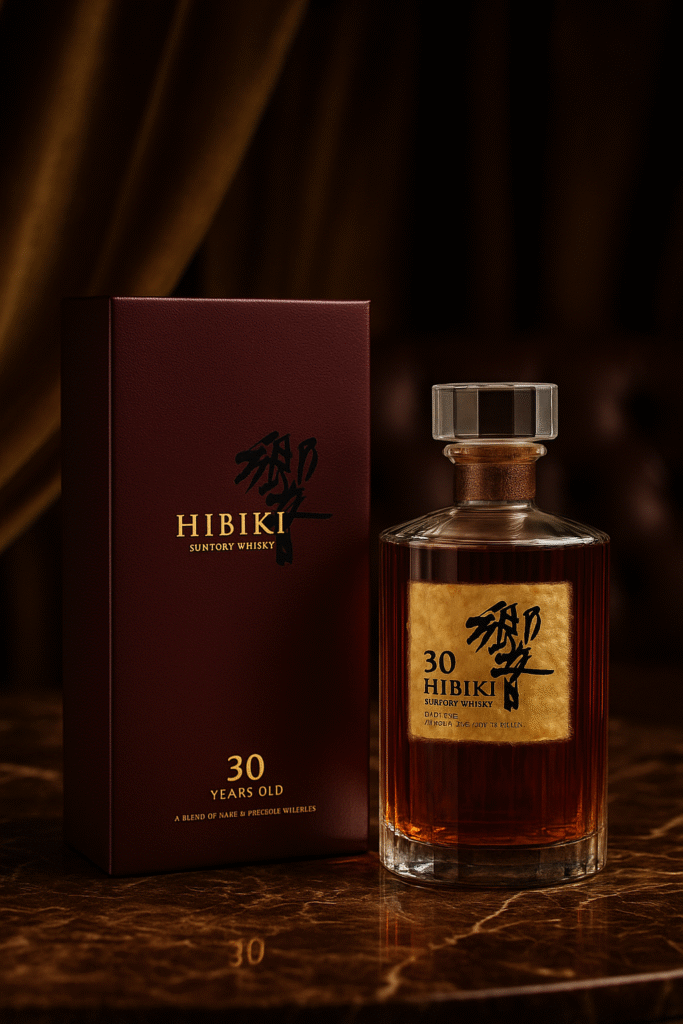
If Yamazaki 25 is a cathedral, Hibiki 30 is a golden shrine. Technically a blend, it incorporates long-aged single malts from Yamazaki and Hakushu alongside rare, mellow grain whiskies. Hibiki 30 is revered not just for its contents but for the totality of its expression: the faceted crystal decanter, the deep burgundy box, and the liquid that glows like polished amber inside.
The nose is a sonata of dried apricot, orange marmalade, quince, and aged honey. On the palate, silky textures deliver toffee, incense, sandalwood, and warm spices. The finish echoes in golden tones, carrying sweetness and light long after the sip is gone. Hibiki 30 is perhaps the most literal embodiment of the Japanese concept of “wa”—harmony—not only in flavor balance but in how it bridges malt and grain, east and west, tradition and innovation.
Secondary prices for Hibiki 30 often soar above $10,000, and its scarcity has only amplified its allure. Yet those fortunate enough to taste it remark not on its price, but on its seamlessness. There is no rough edge, no abruptness—just a continuous thread of elegance that makes time feel slower and more deliberate.
It is the whisky most likely to be displayed rather than consumed, yet its ultimate purpose is the opposite: Hibiki 30 is a celebration of sharing, a harmony meant to be poured among friends in small, crystalline measures.
Karuizawa 30 Year Old — Ghost Distillery, Eternal Spirit
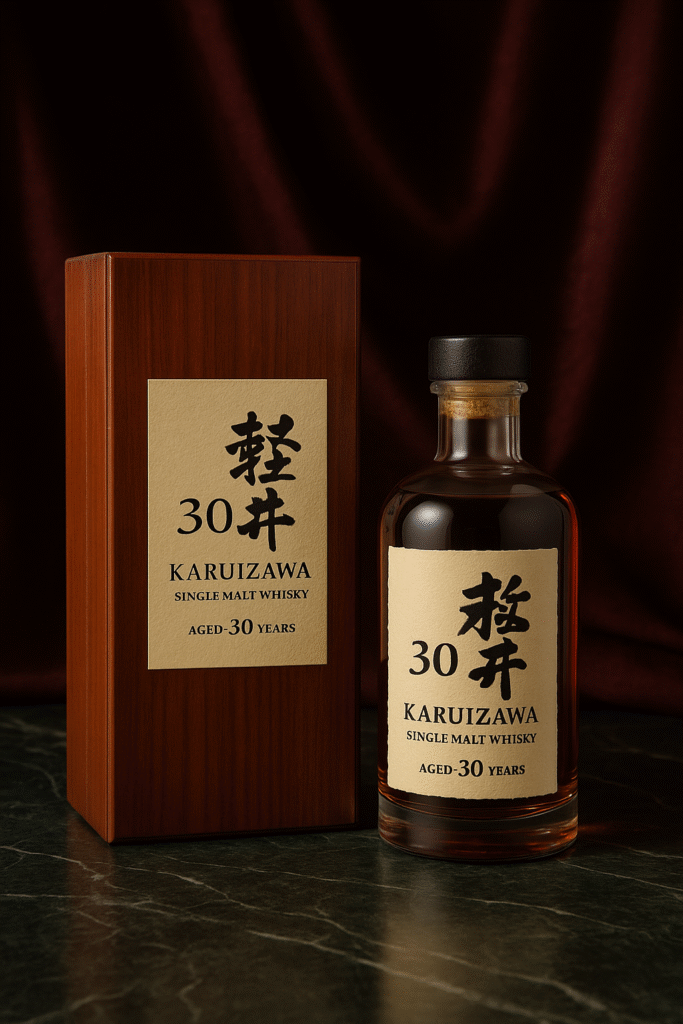
Few names in whisky evoke as much reverence as Karuizawa. Founded in 1955 at the foot of an active volcano, the distillery produced a heavily sherried, robust spirit that became legendary after its closure in 2000. Today, surviving stocks are liquid ghosts, bottles that feel more like artifacts than beverages. Among these, the Karuizawa 30 Year Old stands as a pinnacle.
In the glass, Karuizawa 30 plunges into darkness. Aromas of prune, fig, leather-bound books, and cigar smoke rise from the sherry-soaked spirit. The palate is thick and chewy, carrying notes of bitter chocolate, espresso, and dried fruit compote, all wrapped in oak that is firm but not oppressive. The finish is smoky incense and old libraries—an almost haunting presence that lingers like a memory you can’t shake.
The rarity of Karuizawa lies in finality: there will never be more. Each bottle opened diminishes the living stock. Auction prices range from $5,000 to $15,000, depending on the cask and label, and collectors pursue them with the fervor of art dealers. Yet for those who drink, Karuizawa delivers something few whiskies can: a sense of vanished time captured and released with each pour.
Every sip is a small act of preservation. In drinking Karuizawa, you participate in its afterlife, keeping alive a distillery that can no longer create. It is whisky as relic, whisky as memory, whisky as time itself.
Hanyu Ichiro’s Malt “Card Series” — The Collectors’ Deck
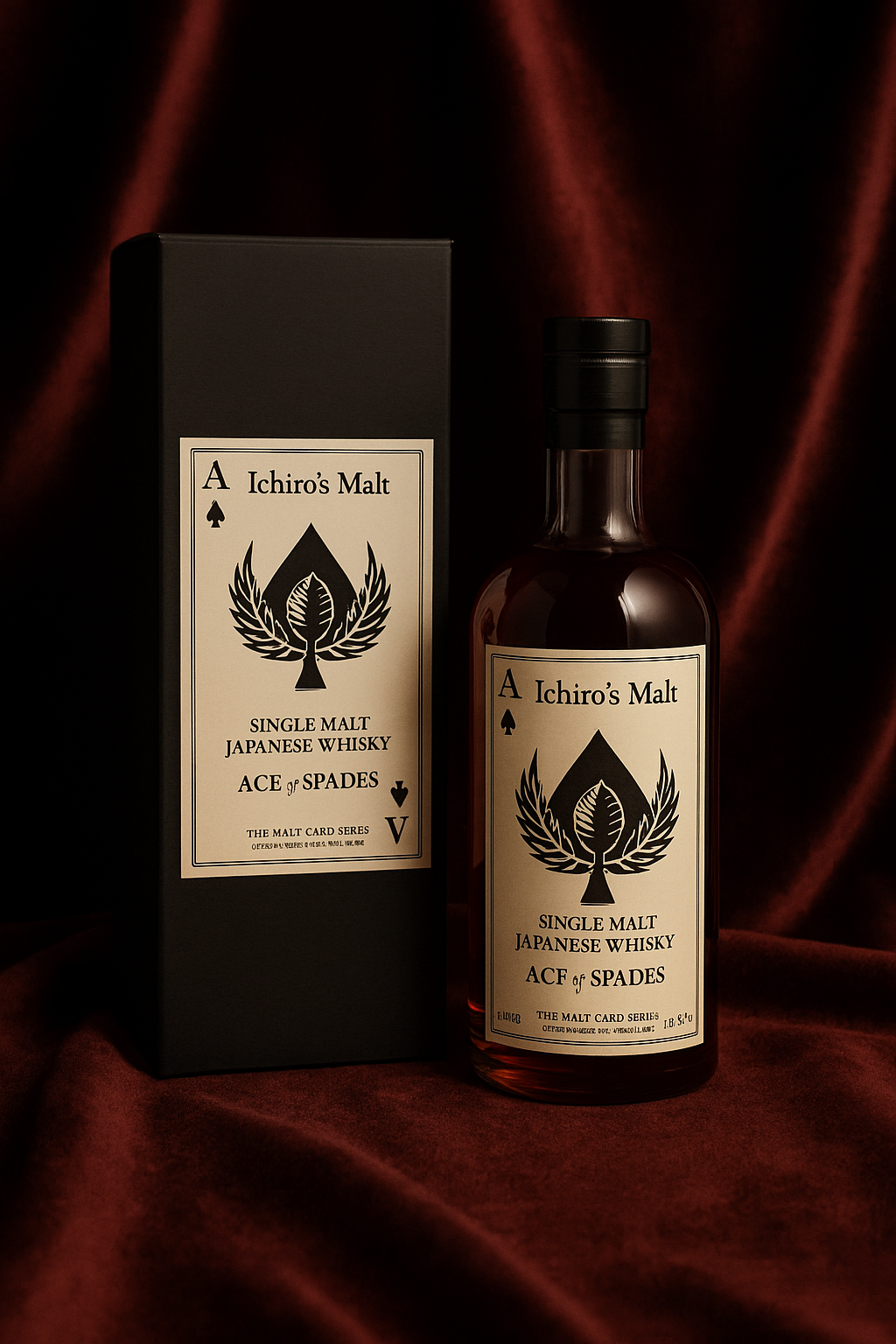
Perhaps no Japanese whisky series has captured the imagination of collectors like the Hanyu “Card Series.” Between 2005 and 2014, Ichiro Akuto bottled 54 single casks from his family’s closed Hanyu distillery, each labeled with a playing card. Together, they formed a deck that has become the most sought-after collectible set in whisky history.
Each card tells its own story: some lean sherried, with notes of dark fruit, chocolate, and spice; others lean on Mizunara or bourbon casks, delivering honeyed malt, sandalwood, and orchard fruit. The bottlings are diverse, yet all bear the Hanyu hallmark of clarity, precision, and understated elegance.
The secondary market has elevated the Card Series into near-mythic status. Even the “lesser” cards now fetch between $5,000 and $10,000, while iconic ones such as the Ace of Spades or the Joker reach six figures. Complete decks have been auctioned for over a million dollars. Beyond liquid, they are cultural artifacts: Japan’s most artistic contribution to whisky as collectible design.
For those fortunate enough to open one, the experience is profound. The liquid is elegant and refined, with layers of fruit, wood, and spice that unfold like pages in a storybook. To collect a card is to hold a talisman; to drink one is to participate in living history. Together, the 54 bottles are more than a deck—they are a narrative of loss, rescue, and rebirth.
Chichibu The Peated 10 Year Old (Limited) — The Future’s Investment
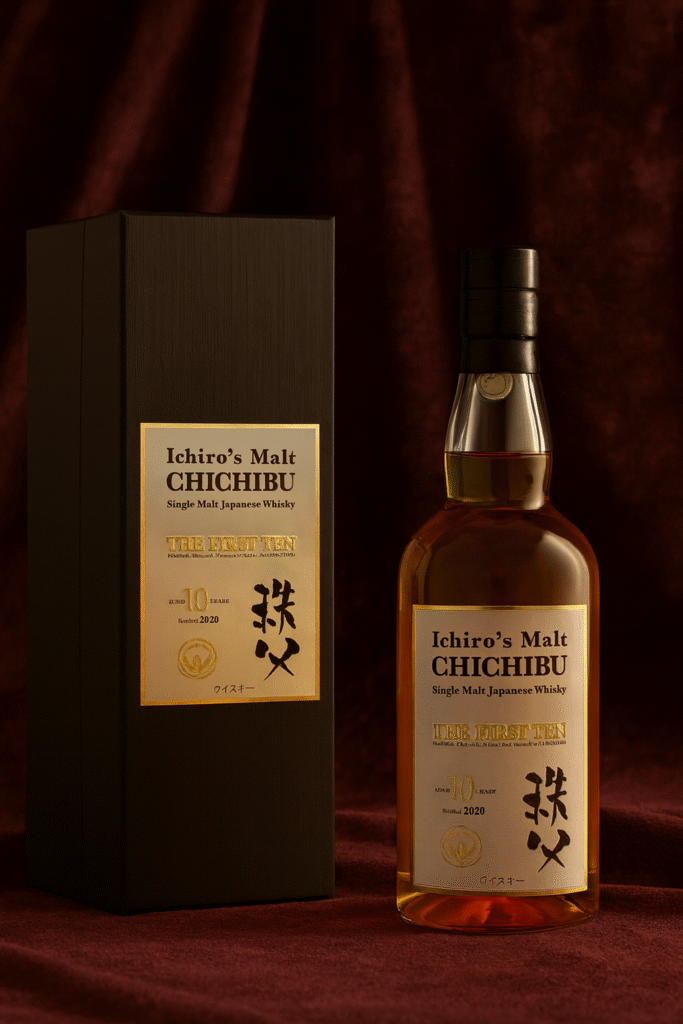
While Yamazaki, Hibiki, Karuizawa, and Hanyu represent Japan’s past and present, Chichibu represents its future. Founded in 2008 by Ichiro Akuto, Chichibu has become a cult distillery in record time. Its small-scale, hands-on production and obsessive attention to detail have set it apart. Among its rarest releases, the Chichibu Peated 10 Year Old Limited Edition has already crossed into the $1,000 tier, proving its place among legends.
The whisky itself balances glowing embers with orchard fruit, honey, and clean malt. The peat is elegant—never harsh—more a memory of smoke than a bonfire. Vanilla, nutmeg, and oak frame the flavors, while the texture remains vivid and modern. The finish is clear and precise, a signal of Chichibu’s philosophy: clarity, honesty, and balance.
Production is tiny, bottlings are hand-finished, and global demand far exceeds supply. Collectors see Chichibu as “the next Karuizawa,” but the truth is it’s carving its own legacy. Where Karuizawa is a vanished ghost, Chichibu is a living spirit: the future of Japanese whisky written today in small, shining editions.
To own a Chichibu is to bet on tomorrow. To drink it is to taste the promise of what Japanese whisky still has to say in the decades ahead. Among this five-bottle pantheon, Chichibu is the exclamation point—the declaration that Japan’s story is still unfolding.
A Five-Bottle Pantheon
Together, these five bottles form a pantheon of Japanese whisky. Yamazaki 25 is incense and cathedral. Hibiki 30 is harmony and gold. Karuizawa 30 is memory and ghost. Hanyu’s Cards are art and myth. Chichibu Peated 10 is promise and future. To hold them is to hold nearly the entire arc of Japanese whisky history—from the first distillery in 1923 to the cult bottles still being born today.
These whiskies occupy a different realm than casual drams. They are cultural heritage, investment, artistry, and celebration in liquid form. To collect them is to preserve; to drink them is to participate. In both cases, they remind us that whisky at its highest level is not a product but an experience: a conversation between time, nature, and human craft.