The New Grand Tour: How to Travel in the Age of Discretion
–
There was a time when luxury travel meant arrival — the grand hotel, the gloved porters, the glittering soirées. But in the twenty-first century, travel among the ultra-wealthy has turned inward. The new grand tourer seeks privacy, authenticity, and belonging. They travel to be unobserved — to slow the clock, not race it. They journey to savor the texture of linen sheets at dawn, the fragrance of cedar and ink in a Kyoto temple, the silence that lingers between bells in Tuscany. Their wealth allows access, but their discernment defines experience.
Japan: Silence, Ritual, and the Geometry of Grace
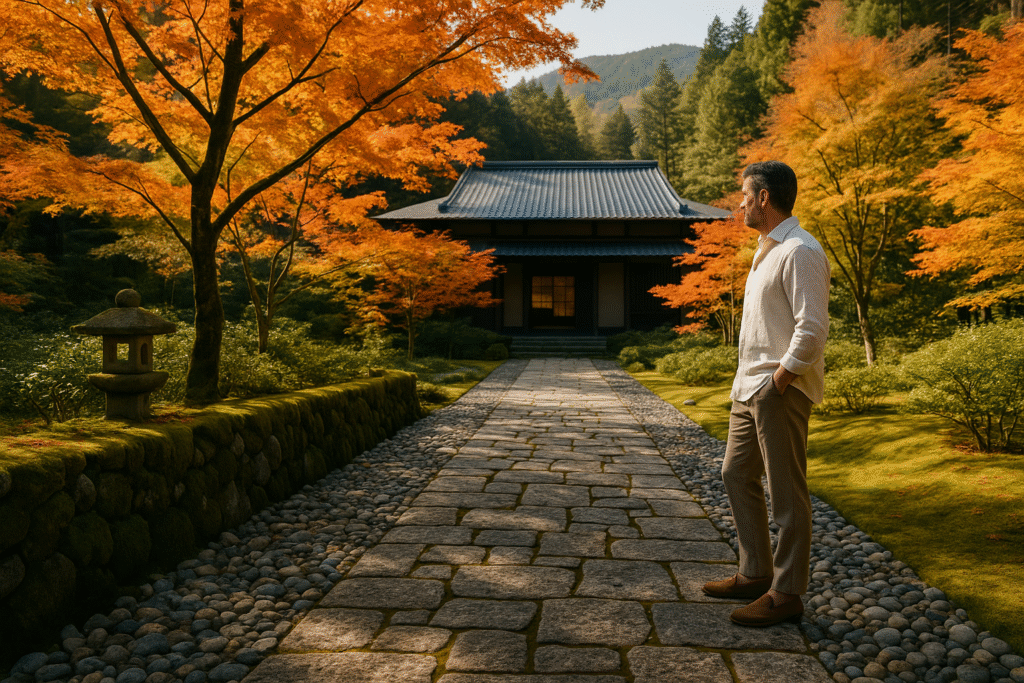
Japan’s relationship with luxury is not about opulence; it is about precision, restraint, and harmony. In Kyoto, beneath the filtered light of maple canopies, Aman Kyoto sits like a haiku rendered in stone and shadow. Each pavilion is surrounded by moss gardens, each corridor scented with cedar and hinoki. Guests arrive not to escape, but to dissolve — into tea ceremonies, meditative walks, and baths fed by geothermal springs that rise like memory from the earth.
For the wealthy traveler, Japan offers an education in attention. To stay at Gora Kadan in Hakone is to rediscover stillness. Tatami rooms open to mist-filled valleys; dinners unfold as theatre, with ten courses of kaiseki served like acts in an ancient play. The staff bow, the paper doors slide, and the rhythm of the modern world fades. A week in such a place costs between $8,000 and $15,000 — but what one purchases is not luxury, it is reverence.
Beyond the ryokan, Kyoto’s machiya townhouses — once homes of merchants — are being reborn as private retreats. Artisans hand-lacquer beams, replace tatami mats, and install baths of hand-polished cypress. Companies like Haku Hospitality and Kyoto Machiya Stay now curate these for discerning guests. A private townhouse rental starts around $2,000 per night, offering total anonymity within Japan’s most spiritual city.
In winter, a private journey by rail through Japan reveals another layer of beauty. Chartering a cabin on the Shiki-Shima train — known as Japan’s “moving ryokan” — grants access to a world where every curve of track feels choreographed. Hand-cut crystal glasses tremble with sake as the countryside passes: cedar forests, silent villages, shrines dusted with snow. Such experiences, at roughly $15,000–$25,000 per couple, transform motion into meditation.
Here, wealth manifests not as extravagance, but as invisibility — the freedom to experience beauty without interruption, to exist fully in the architecture of quiet.
Italy: Heritage, Sunlight, and the Alchemy of Time
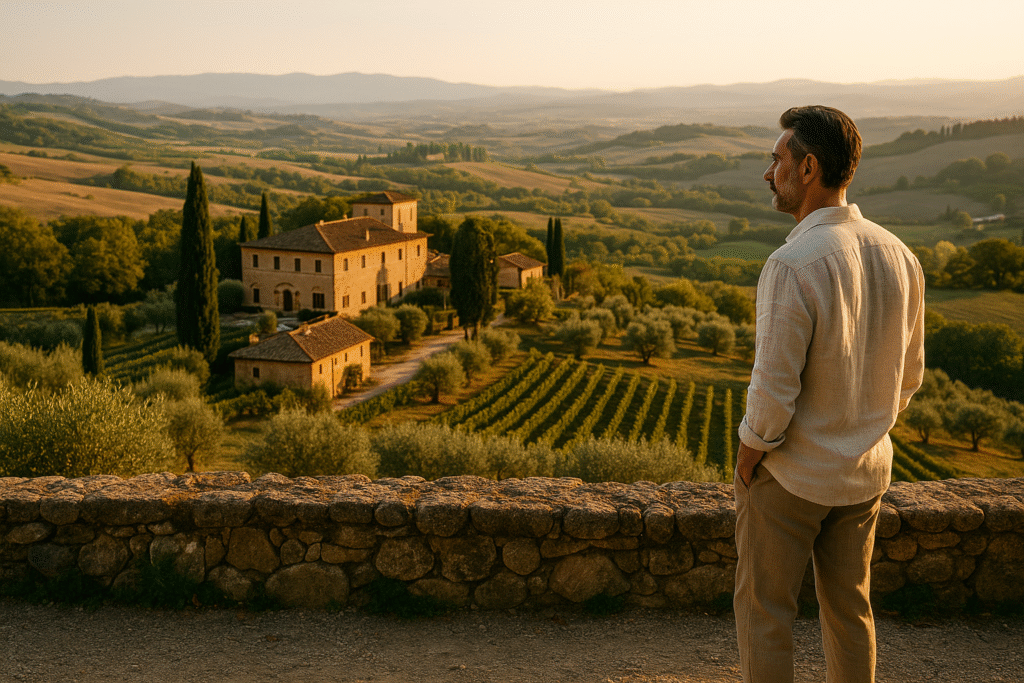
Italy is less a destination than a state of grace — a civilization suspended between decadence and devotion. The Tuscan hills have become sanctuaries for those who crave beauty in its purest, most pastoral form. Here, among cypress and vineyard, Rosewood Castiglion del Bosco and Borgo Santo Pietro define the art of rural refinement. Days begin with truffle hunts or horseback rides through the Val d’Orcia, afternoons with Brunello tastings under pergolas dripping with wisteria.
Suites at Castiglion del Bosco begin around $1,800 per night, but the appeal lies in its rhythm — the way the light stretches across the vineyards, the way dinner unfolds as if time itself has slowed to join you. In the nearby abbey towns, chefs whisper old recipes to new guests; artisans craft shoes and olive oil with the same patience as monks copying manuscripts.
Further north, Lake Como remains an icon of aristocratic leisure — though its best moments now belong to those who arrive discreetly. At Il Sereno, designed by Patricia Urquiola, minimalism meets the lyricism of Italian light. The infinity pool merges with the lake, the Riva boat waits at dawn. Across the water, Villa d’Este keeps its old-world glamour alive, where garden walks and espresso at the terrace still feel like scenes from a Fellini film.
Private villas line the upper hillsides, many now bookable through Luxury Retreats or Edge Retreats. Summer rates often exceed $25,000 per week, with concierge chefs and drivers included. It is not uncommon for families to arrive via private seaplane from Geneva, their arrival known only to the villa staff and the mountains themselves.
In Italy, luxury is never loud. It is found in olive oil pressed by hand, frescoes preserved in monasteries, linen that carries the scent of the sun. And when evening falls, one realizes that Italy is not something to be seen — it is something to be remembered, over and over again.
The South Pacific: Islands of Silence and Sustainability

For those who have seen every capital and crossed every ocean, the South Pacific remains one of the few places on earth that still feels undiscovered. Beyond Bora Bora’s postcards lies a network of islands where time is not measured by hours but by tides. In Fiji, Laucala Island embodies this balance between isolation and indulgence — a private world of coconut plantations, coral reefs, and villas carved into volcanic cliffs. Guests arrive by private jet, greeted not by a lobby but by the scent of frangipani carried on salt air.
Each villa is an ecosystem of its own: infinity pools fed by freshwater springs, timber sourced from sustainable forests, linens woven locally. The cuisine is drawn almost entirely from the island’s own farms. A week’s stay begins around $25,000 and rises past $60,000 for the Overwater Residence. Yet wealth here feels irrelevant; every sunset makes one forget currency altogether.
Across the Pacific, on Tetiaroa — Marlon Brando’s private atoll — The Brando resort carries sustainability into sanctity. Solar fields power villas that float above turquoise lagoons, while marine biologists guide guests through coral nurseries and turtle sanctuaries. Private seaplane transfers from Tahiti complete the ritual of arrival: a descent into stillness.
In these islands, discretion is effortless. No paparazzi, no reception desks — only the hush of palms and the weightless sensation of belonging nowhere and everywhere at once. This is the geography of renewal, where silence becomes a form of luxury.
Iceland: The Edge of the Elements
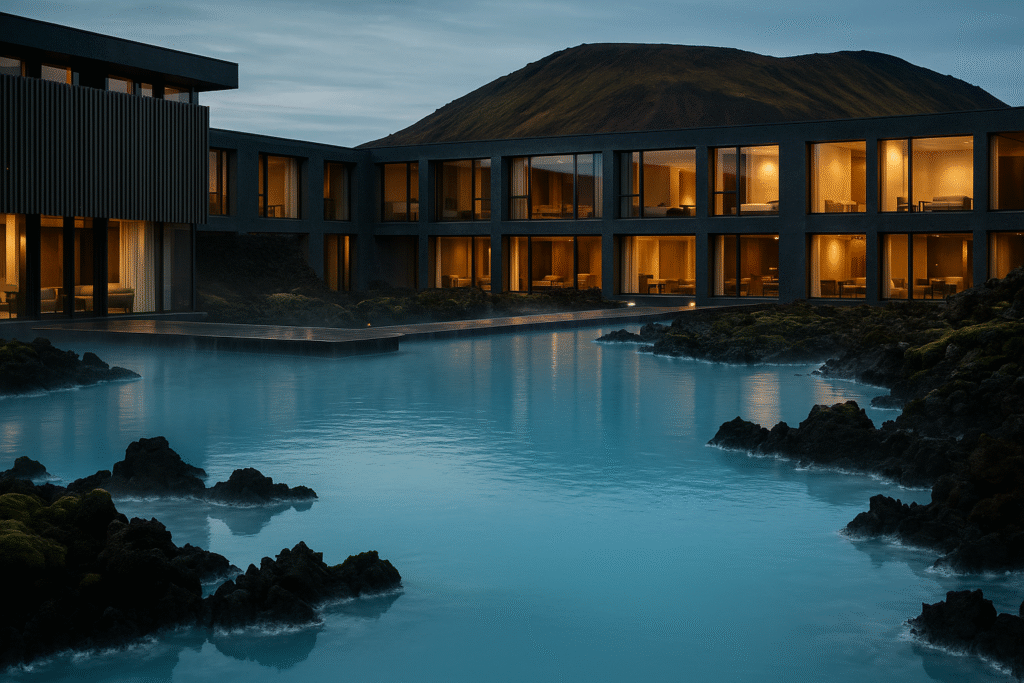
At the northern frontier of the world, Iceland feels like a planet still in the process of creation. Here, luxury means survival elevated to art. The Retreat at Blue Lagoon appears half-born from lava — its basalt walls alive with warmth and mist, its pools a luminous turquoise that mirrors the aurora. The suites, all glass and silence, gaze over a landscape that is simultaneously lunar and deeply human. Rates hover around $2,000 per night, but what one purchases is the privilege of witnessing the earth breathe.
Adventurous guests commission helicopter journeys over the Þórsmörk valleys, ice tunnels beneath Langjökull glacier, or private dinners on cooled lava fields where chefs grill arctic char over volcanic heat. Companies such as Luxury Adventures Iceland curate itineraries that merge geology with gastronomy. The price of these bespoke expeditions — typically $25,000–$40,000 per couple for a week — is outweighed by the feeling of standing at the world’s edge, wind and fire speaking an ancient language.
In Iceland, luxury is tactile: the crunch of ice beneath boots, the shimmer of northern light on snow, the quiet hum of geothermal energy rising from beneath one’s feet. It reminds even the most sophisticated traveler that wealth cannot outshine wonder.
The Journey Itself: Trains, Yachts, and the Art of Motion

There are journeys where the destination ceases to matter. Aboard the Venice Simplon-Orient-Express, one travels through history, not geography. The train gleams in navy and cream, its corridors lined with polished brass and Lalique panels. Dinner is served on starched linen as alpine peaks roll past the window. Suites begin near $8,000 per person, and for 48 hours time itself becomes ornamental — an indulgence in nostalgia perfected.
At sea, movement becomes meditation. Aboard a Burgess Yacht cruising the Cyclades or Explora Journeys’ floating residences, the horizon is infinite and the itinerary optional. Crew move like choreography; champagne flows as quietly as the wake behind. A weeklong charter begins near $150,000 and may crest $1 million for superyachts with helipads, spas, and Michelin-trained chefs. The true cost, though, is time — the luxury of having nowhere to be except between two shades of blue.
Final Reflections — Private Access, The Economics of Exploration, and The Grand Tour of Tomorrow
The new elite no longer travel to be seen. They travel to see — to understand, to collect moments of stillness and authenticity. Agencies such as Abercrombie & Kent Private Client Group or Black Tomato now design experiences that transcend even wealth: after-hours access to the Sistine Chapel, sunrise over Machu Picchu with no one else in sight, an archaeological dig in Luxor led by Egyptologists who speak softly of eternity.
Economically, luxury travel has become a new asset class — a way of preserving identity rather than capital. Family offices increasingly allocate up to 8% of discretionary budgets to curated journeys, blending philanthropy, sustainability, and legacy. The value lies not in extravagance but in the creation of shared memory — a portfolio of wonder passed down like art or estate.
As the world grows louder, the most sophisticated travelers seek quiet. They no longer measure success by check-ins or itineraries but by the depth of a single morning: mist rising over Kyoto, a Tuscan breeze across vineyard walls, the hum of a train entering the Alps. The New Grand Tour is not a race across continents; it is a return to presence — to beauty savored, not consumed.
–