Aston Martin DB12 — The Super Tourer, Explained
Editorial note: Facts & specifications referenced from Aston Martin’s official materials and independent road tests. Figures can vary by market/tyre/specification.
–
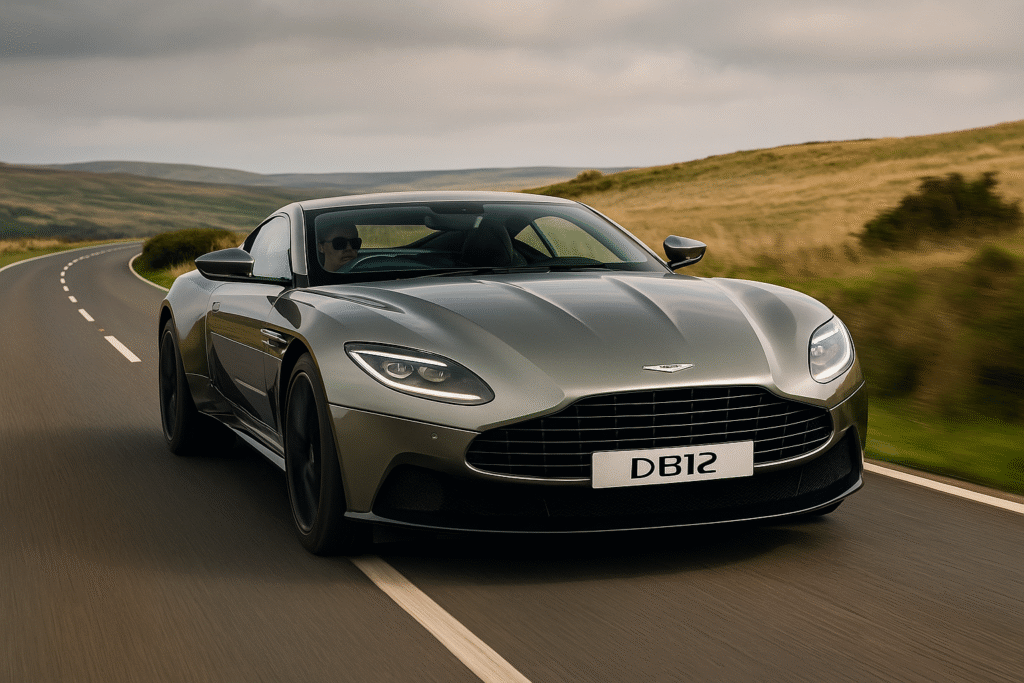
The DB12 arrives with a refreshed mission statement: less languid GT, more alert Super Tourer. Power comes from a twin-turbo 4.0-liter V8 tuned to about 671 hp and 800 Nm, enough for a 202 mph top speed when conditions allow. The bonded aluminum structure is stiffened, the chassis electronics sharpened with an electronic rear differential, and braking performance elevated with optional carbon-ceramic rotors. Inside, Aston ditches the previous Mercedes-based UI for its own infotainment, finally integrating wireless CarPlay/Android Auto, and a cabin that feels tailor-cut rather than mass-produced. It’s a meaningful evolution that places the DB12 squarely between high-drama supercars and silk-gloved continent-crushers.
Design & Presence
There is a particular Aston way of occupying space: sinewy panels stretched over a long hood, a tucked waist, and that classic grille that reads like a signature. On the DB12, surfaces are tauter, lines more assertive. It’s elegant, yes, but with the posture of a thoroughbred that’s just heard the paddock bell. The cabin continues the theme: dense, perfumed leather; cold metal knurled into tactile controls; and a dashboard that curves like a tailor’s pattern. It’s less fashion, more craftsmanship — and crucially, less generic than before.
Powertrain: The Heart
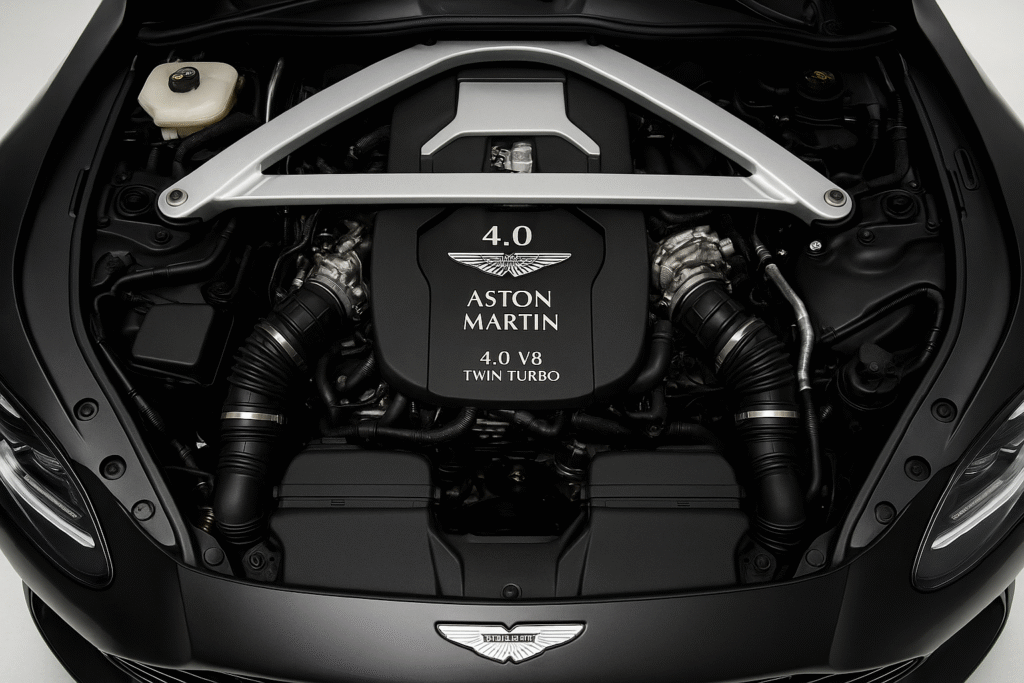
The twin-turbo 4.0-liter V8 is familiar in architecture but transformed in tune. Aston’s calibration gives it the kind of mid-range thrust that shrinks geography; torque rolls on with an almost turbine calm, then crescendos into a metallic snarl as revs rise. Paired to the ubiquitous-but-excellent ZF 8HP automatic, shifts are clean and decisive in the faster modes, relaxed and near-imperceptible in GT settings. The magic, however, is the elasticity: in the span of one on-ramp you glide, surge, and then cruise — always with a sense of abundant headroom. Independent testing and factory figures converge on a 202 mph v-max and low-3-second 0–60 mph capability depending on surface and tyres.
Chassis, Steering & Brakes
What differentiates DB12 from its predecessors is its spine. The bonded aluminium structure benefits from a claimed 7% increase in global torsional stiffness via reinforced underbody components and bracing. The result reads not as raw harshness but as clarity: suspension inputs feel precisely located; the platform resists twist when you breathe on the throttle mid-corner; and the whole car communicates in complete sentences rather than fragments. An electronic rear differential (E-Diff) arrives to vector torque with more nuance than a purely mechanical unit, giving the Aston a sense of rotation that flatters drivers on unfamiliar roads. Optional carbon-ceramic brakes (400 mm front, 360 mm rear) bring track-resilient fade resistance and shave unsprung mass by around 27 kg, giving the steering a cleaner, less inertia-laden feel over poor surfaces. 2
Ride Quality & NVH
Adaptive dampers carry a wide bandwidth. In the softest mapping, the DB12 breathes with the road in a way that recalls classic GTs; in its firmer settings, vertical movements are well-controlled without crossing into brittleness. Tyre roar is present on coarse aggregate — an inevitable tax for contact patches this substantial — but wind noise is impressively restrained at legal touring velocities. That the car can be serene at 80 mph and composed at very illegal multiples is the whole point of a super tourer.
Interior, Infotainment & HMI
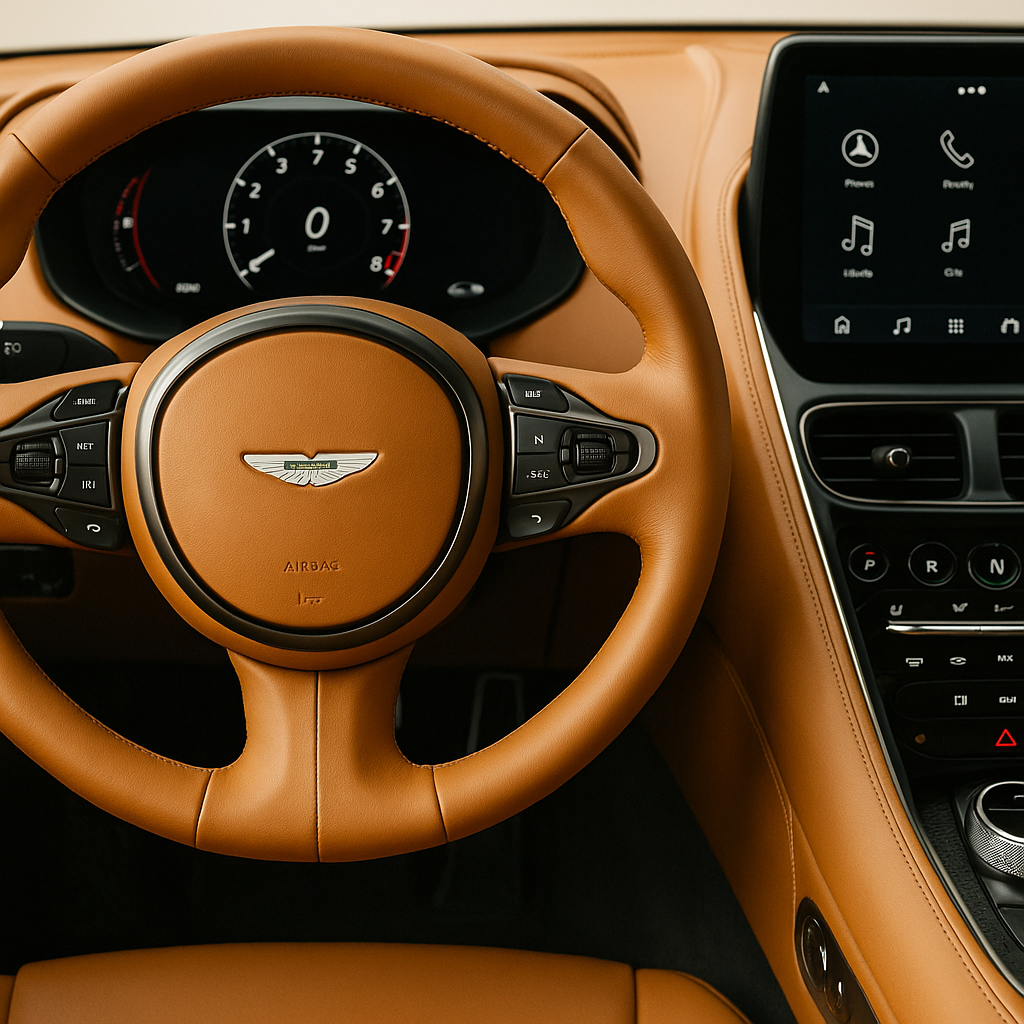
Aston’s new infotainment suite finally feels bespoke. The 10.25-inch touchscreen presents crisp graphics, a clean home layout, and quick access to vehicle functions; climate remains mercifully on physical switchgear. Wireless Apple CarPlay and Android Auto come baked-in, and the UI latency is minimal — the experience is less borrowed and more brand-native than before. The driving position is low without being louche; sightlines are good over the crested bonnet; and the wheel, paddles, and primary controls fall to hand naturally. Rear seats remain occasional at best, but the boot can handle weekender luggage with more grace than the DB12’s silhouette suggests. 3
Numbers That Matter
| Specification | DB12 (Coupe) | Notes / Source |
|---|---|---|
| Engine | 4.0L twin-turbo V8 (M177 family) | Factory / platform info; AMG-derived architecture |
| Power | ≈ 671 hp (680 PS) | Independent tests & launch data |
| Torque | ≈ 800 Nm | As above |
| Transmission | ZF 8-speed automatic | Rear-drive, E-Diff fitted |
| Top speed | 202 mph | Car and Driver spec page. 4 |
| 0–60 mph | ~3.3–3.5 s (est.) | Independent testing. 5 |
| Kerb weight | ~1,685–1,788 kg | Wiki/Factory ranges (market spec dependent). 6 |
| Weight distribution | 48:52 (F/R) | Factory data. 7 |
| Chassis | Bonded aluminium, +7% torsional stiffness | Factory release. 8 |
| Brakes (optional) | Carbon-ceramic 400 mm / 360 mm | Factory dealer pages. 9 |
| Infotainment | 10.25″ screen; wireless CarPlay/Android Auto | TrueCar overview. 10 |
| Dimensions | L 4725 mm / W 1980 mm / H 1295 mm / WB 2805 mm | Factory / Wikipedia. 11 |
| Boot volume | ≈ 262 L | Factory spec. 12 |
On a Great Road
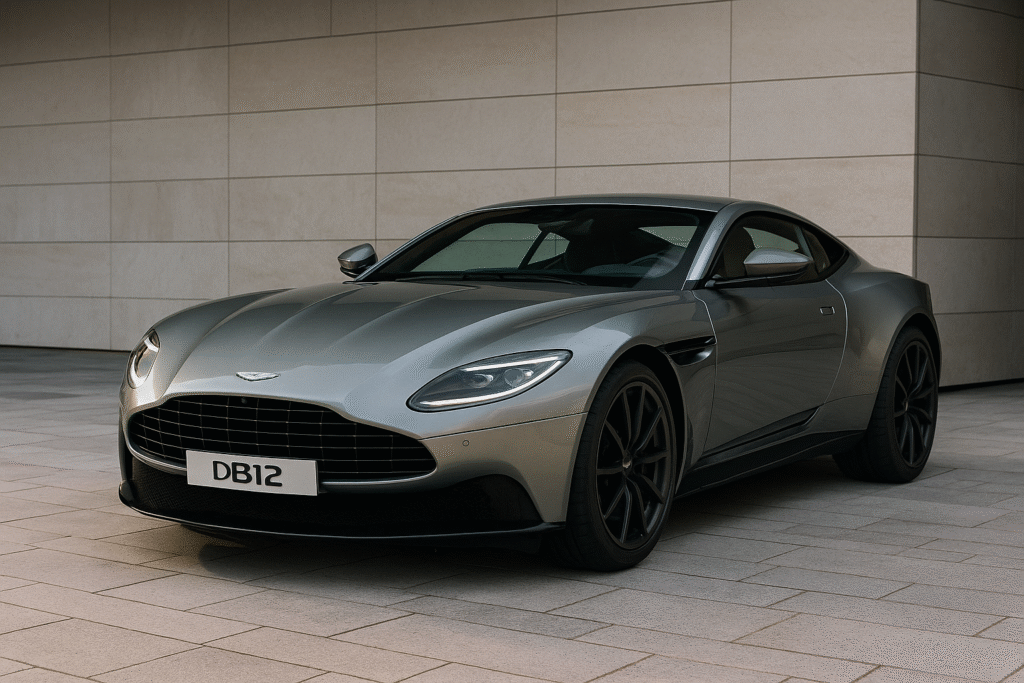
Find a ribbon of two-lane that climbs, kinks, and exhales into wide valleys. In GT mode, the DB12 is velvet: throttle tip-in is measured, the gearbox barely present, the cabin vault-quiet. Toggle into more aggressive mappings and the car tightens its core. The steering isn’t hyperactive — instead it’s naturally weighted with a pleasing linearity off-center. There’s genuine precision at the front axle; the E-Diff lets you lean on the torque early and feel the rear track settle rather than smear. The optional ceramics take repeated heavy stops without losing the high, hard pedal you want on Alpine descents. It’s not a track refugee forced to wear a dinner jacket — it’s a grand tourer taught new language.
Daily Use & Long Hauls
As a daily, visibility is workable, ride is supple enough in softest damper mode, and the cabin tech no longer feels like an aftermarket addition. The 78-liter tank gives respectable legs on the autoroute. Luggage space is honest for a 2+2, and the front seat ergonomics suit long torsos thanks to travel and rake that let you sit low and supported. If you cross continents with a partner and two weekender bags, the DB12 serves the brief beautifully, arriving with your pulse intact.
Craft & Materials
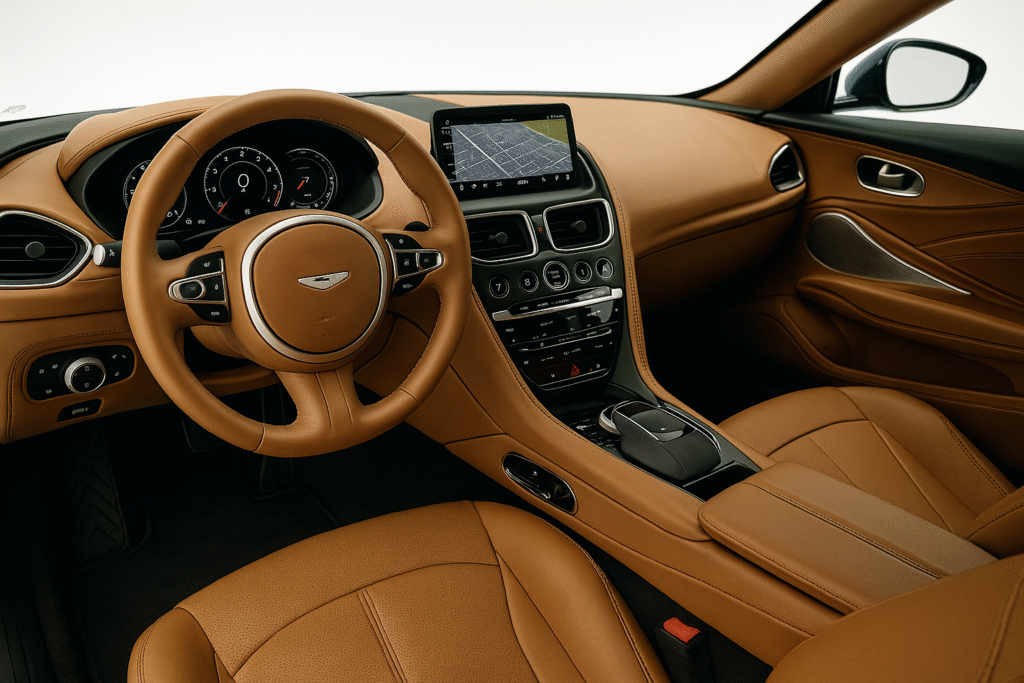
Leather density, stitch density, edge finishing — these are the details that separate a luxury car from an expensive car. The DB12 cabin bears the marks of handwork: consistent stitch runs, tight grain alignment, precise perforation. Switchgear has weight; the alloy paddle shifters click like a Leica shutter. You feel where the money went. It’s an environment that encourages calm focus, which ironically makes you drive more smoothly and — by extension — more swiftly.
Ownership Economics
This is not an inexpensive proposition to run. Tyres are wide and sticky, fluid services are precise, and paint loves gentle, frequent detailing. But residuals for modern Aston GTs have strengthened as the brand’s product cadence and quality have improved. The DB12’s blend of performance and elegance places it in a sweet spot — rarer than a mass-built super-GT, yet modern enough in tech to avoid the friction of older exotics.
Rivals & Positioning
The Bentley Continental GT Speed leans more toward opulence and all-weather competence; the Ferrari Roma sings with a purer sports-car intonation; Porsche’s 911 Turbo S is a clinical miracle. The DB12 threads a line between charisma and control — less brash than the Italian, more emotive than the German, and sportier than the British rival from Crewe. It sells you the idea that speed can be romantic again.
Verdict
With added stiffness in its bones, stronger lungs, and a clearer digital voice, the DB12 delivers on the “Super Tourer” promise. It’s a car that charms at 30 mph and convinces at 130. If your vision of luxury includes a long road, a light bag, and a horizon that keeps refusing to arrive, this is your key.
Appendix: Dimensions & Interior Metrics
| Wheelbase | 2,805 mm | Factory/Wiki. 13 |
| Length | 4,725 mm | Factory/Wiki. 14 |
| Width (excl. mirrors) | 1,980 mm | Factory/Wiki. 15 |
| Height | 1,295 mm | Factory/Wiki. 16 |
| Kerb Weight (EU incl. lightweight options) | 1,788 kg | Factory spec. 17 |
| Weight Distribution (F/R) | 48 / 52 | Factory spec. 18 |
| Boot Volume | 262 L | Factory spec. 19 |
Chassis note: structural stiffening claimed at +7% global torsional rigidity; subjective improvements in lateral fidelity felt at the strut towers through to rear axle mounting points. 20
Appendix: Brake & Tyre Package
Optional carbon-ceramic discs (400 mm front, 360 mm rear) resist fade at track-adjacent temperatures and cut unsprung mass ~27 kg vs. iron sets — noticeable in steering delicacy on broken surfaces. 21
Appendix: Infotainment & UX
New Aston-designed infotainment replaces the older, licensed interface. Core wins: faster boot, logical menuing, retained physical HVAC controls, and standard wireless CarPlay/Android Auto. 22
–