The Art of Wealth Preservation Through Collectibles
Disclaimer: This feature is for educational purposes only and is not investment, legal, tax, or insurance advice. Consult qualified professionals before acting.
Why Collectibles Belong in a Modern Portfolio
Collectibles occupy a unique corner of wealth management. They are at once tangible pleasures and financial assets, combining the tactile joy of ownership with the sober discipline of wealth preservation. Unlike equities or bonds, a painting can silence a room, a car can stir the soul, and a watch can pass through generations as a legacy. For families of means, the appeal lies not merely in diversification, but in possessing something real, scarce, and imbued with cultural value. In times of inflation, scarcity-driven markets like art and jewelry can retain value long after financial markets stumble. Yet, to play in this arena requires discernment, patience, and an appreciation for more than numbers on a balance sheet.
Here are a few key reasons why you may want to consider collectibles as part of your portfolio:
- Diversification: Lower correlation to stocks and bonds over long arcs, especially for top-decile pieces.
- Inflation sensitivity: Scarcity + global collector demand often supports real pricing in inflationary climates.
- Expertise premium: Knowledge and access materially impact returns—buying the right reference, artist period, or provenance is everything.
Historical Performance Snapshot
Returns vary widely by quality tier, holding period, and market cycle. The table below offers indicative ranges seen over multi-year horizons for top-quality segments versus broad baskets. Use this as a directional map, not a guarantee.
| Category | Indicative Long-Run Annual Return* | Volatility | Liquidity | Key Drivers |
|---|---|---|---|---|
| Fine Art (blue-chip) | ~4–9%+ | Medium–High | Low–Medium | Artist demand, museum shows, supply, macro |
| High Jewelry (iconic pieces) | ~3–6%+ | Medium | Medium | Brand, stones’ quality, design era, provenance |
| Collector Cars (tier-one) | ~5–10%+ | High | Medium | Rarity, racing pedigree, originality, condition |
| Fine Watches (grail references) | ~4–8%+ | Medium | Medium–High | Brand/reference, condition, scarcity |
| Alt Collectibles (wine, whisky, sneakers, comics) | ~3–8%+ | Medium–High | Medium | Hype cycles, grading, storage, platform liquidity |
Fine Art: Canvases as Currency
Few asset classes marry beauty and capital like fine art. A Rothko hung in a Manhattan penthouse is not just pigment on canvas, but a store of wealth that museums covet and auction houses compete for. Over decades, blue-chip artworks have delivered annualized returns of 4–9%, their performance spiking when global liquidity swells. A single retrospective at MoMA can ignite decades of value appreciation. Unlike stocks, however, liquidity is elusive: when the hammer falls at Sotheby’s or Christie’s, the market can reprice an entire artist overnight. The art world is as much theater as finance — its actors include collectors, curators, critics, and estates carefully managing scarcity.
Storage and protection matter as much as provenance. The most valuable works often slumber in Swiss freeports — climate-controlled, tax-friendly vaults where the air is filtered and the light never fades. Provenance files become as precious as the paintings themselves: bills of sale, exhibition histories, and catalogues raisonnés form the DNA that assures authenticity. Without this paperwork, even the most brilliant canvas can lose its liquidity. Insurance must be nail-to-nail — from gallery wall to private jet, and onward to vault — because art is fragile currency.
What Holds Value

- Artist quality: Museum collections, major retrospectives, critical scholarship.
- Work quality: Signature periods, iconic motifs, strong condition, documented provenance.
- Supply dynamics: Few comparable works available; estates controlling release cadence.
Performance & Cycles
Blue-chip indices have delivered mid-single to high-single-digit annualized returns across long arcs, with sharper drawdowns during liquidity shocks. Top-tier masterpieces can compound above the mean, while speculative segments can lag or whipsaw.
Storage & Custody
- Freeports & bonded facilities: Climate-controlled, tax-efficient transit/holding (check local rules).
- Condition reports: Before acquisition and periodically; UV/IR imaging for high-value works.
- Provenance file: Bills of sale, exhibition history, catalog raisonnés, authenticity letters.
Insurance
Schedule each work on a valuables policy with agreed value, nail-to-nail transit coverage, and restoration riders. Annual appraisals for major pieces.
Jewelry and Stones: Eternity in a Carat

High jewelry carries with it an intimacy that few other collectibles can match. A sapphire worn at a gala in 1925 glitters just as vividly under today’s lights. The value of these stones lies in their rarity: untreated Burmese rubies, Kashmir sapphires with their velvety hue, and flawless Type IIa diamonds command premiums far above the rest. The great maisons — Cartier, Bulgari, Van Cleef & Arpels — have become almost secondary guarantors of value; a signature on a jewel’s certificate can elevate it from accessory to asset. Historical collections, such as Elizabeth Taylor’s Bulgari trove, have shown how celebrity provenance can send prices soaring at auction.
Here too, documentation is destiny. A GIA certificate or maison archive can be the dividing line between a stone traded as an investment and one treated as mere ornament. Jewelry markets are less volatile than art but no less cyclical, with signed vintage pieces finding renewed demand when styles revive. Jewelry’s portability makes it uniquely powerful: unlike a painting or car, a necklace worth millions can fit in the palm of one’s hand. But with portability comes risk. Insurers stress “mysterious disappearance” clauses, while collectors maintain vaults and safes designed to withstand not only burglars, but time itself.
What Holds Value
- Certificates: GIA/GRS/SSEF for stones; maison archives for signed pieces.
- Stone quality: Color saturation, clarity, cut, carat; rarity (origins & treatment status).
- Design & period: Art Deco and iconic house motifs tend to endure.
Performance & Cycles
Top-tier stones have delivered steady mid-single-digit appreciation with bursts during supply squeezes. Signed vintage jewelry can outperform during revival cycles and major retrospectives.
Storage & Insurance
- Bank vault or home safe with UL rating; separate, discreet storage for travel.
- Valuables policy with mysterious disappearance coverage; annual reappraisal.
- Keep boxes, pouches, and paperwork—packaging adds resale value for signed pieces.
Collector Cars: When Passion Fuels Performance
The roar of a carbureted Ferrari V12, the click of a gated shifter, the scent of aged Connolly leather — collector cars live at the intersection of art and engineering. Unlike contemporary supercars, classics cannot be replicated; their rarity is absolute, their supply finite. Originality reigns supreme: a Ferrari 250 GTO with matching-numbers chassis and engine can fetch over $50 million, while a re-bodied or heavily restored counterpart lags far behind. Provenance adds another layer of magic — a car once raced at Le Mans or owned by Steve McQueen will always outshine its anonymous sibling.
The market for collector cars has delivered 5–10% annualized returns in top segments, though it is highly cyclical. During booms, prices of rare Porsches and Ferraris can double in a few years; during downturns, liquidity vanishes and sellers must wait. Cars also carry a cost of care. Climate-controlled garages, regular mechanical exercise, and expensive parts are mandatory. Yet for many collectors, these costs are the very point. Unlike stocks, cars can be driven — they are wealth that moves, roars, and leaves tire marks at Pebble Beach or Villa d’Este.

What Holds Value
- Originality: Matching-numbers chassis/engine/gearbox; period-correct components.
- Provenance: Racing history, celebrity/royal ownership, concours awards.
- Production rarity: Limited runs, homologation specials, coachbuilt variants.
Performance & Cycles
Prime segments have delivered mid-to-high single-digit long-run returns, with sharp cyclicality around macro shocks. Iconic models can jump in step-changes after concours wins or landmark sales.
Storage, Maintenance & Insurance
- Climate-controlled storage (humidity 45–55%), trickle chargers, start/drive program to keep seals alive.
- Specialist insurers (agreed value), track-day riders, OEM parts riders; appraise annually.
- Service history in a single binder; photo documentation of restoration phases.
Fine Watches: The Poetry of Precision
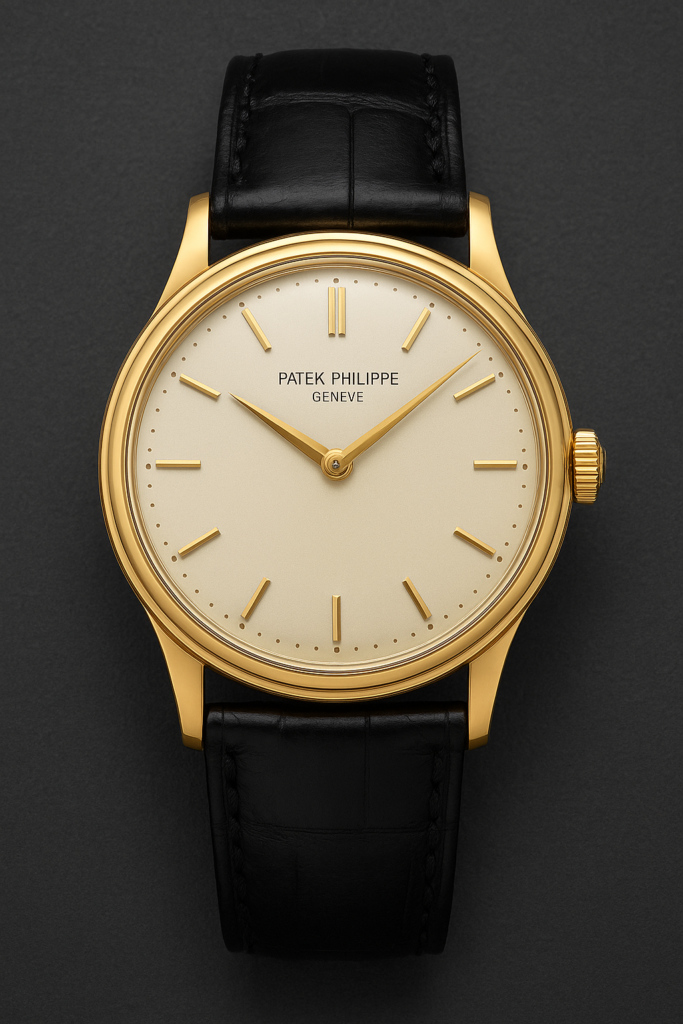
A watch is perhaps the most intimate of all collectibles. It rests on the wrist, ticking against the pulse, a constant reminder of time’s passage. But to the connoisseur, it is also a vessel of mechanical poetry. The Geneva stripes of a Patek Philippe Calatrava are not decoration but history carved into metal. The gliding seconds hand of a Grand Seiko Spring Drive is not a tick but a river flowing silently around the dial. Movements whisper of centuries of craft: Lange’s three-quarter plates of German silver that patinate with age, Rolex’s Chronergy escapements designed to defy magnetism and wear. These details matter because collectors prize not just rarity but honesty of finish — the sharpness of a lug, the untouched bevel on a bridge, the watch that has survived unpolished through decades.
The market for watches is a study in cycles. Hype can push a steel Nautilus to five times retail, only for prices to correct. Yet over decades, the icons endure: Rolex sports models, Patek dress watches, Audemars Piguet’s Royal Oak. They compound wealth quietly, their liquidity higher than art or cars thanks to the vast secondary market. And unlike a canvas in a vault, a watch can be worn daily, its value residing not only in its market price, but in the life lived with it on the wrist.
What Holds Value
- Reference & dial: Desirable references, rare dials, period-correct parts.
- Condition: Unpolished cases preferred; sharp lugs; original bracelet/endlinks.
- Complete set: Box, papers, tags, service history add 5–20% to resale.
Performance & Cycles
Top references have compounded mid-single to high-single digits over long arcs. Momentum phases (hype cycles) can overshoot, followed by healthy mean reversion. Quality endures.
Storage & Insurance
- Desiccant-controlled safe; rotate pieces to keep oils distributed; service on schedule.
- Valuables policy with worldwide wear coverage; proof of ownership photos; appraisals.
- For travel, use discreet watch rolls and separate carry to reduce loss severity.
Alternative Collectibles: Taste as an Asset
Beyond the canonical categories lie emerging markets where taste, timing, and knowledge can yield outsized rewards. A first-growth Bordeaux or a Macallan 1926 becomes both a drink and a bank account, its unopened bottle compounding in value over decades. A rare comic in pristine CGC grading, a rookie card in PSA 10, or a limited-edition sneaker sealed in its box — these markets may seem modern, but they run on the same old laws of scarcity, authenticity, and desire. Here volatility is higher, liquidity thinner, and fraud a constant risk. But for those with the right access and patience, alternative collectibles can round out a portfolio with both diversification and excitement.
Wine & Whisky
- Provenance + storage matter most; OWC (original wooden case) commands premium.
- Long-run returns mid-single digits for blue-chip châteaux/distilleries; fraud risk mitigated via platforms.
Comics, Cards, Sneakers
- Third-party grading (CGC, PSA) drives pricing bands; pop reports signal scarcity.
- Hype cycles are sharp; buy grails, avoid mass-produced limiteds.
From Vault to Balance Sheet: Storage, Insurance, and Collateral
To convert beauty into bankable wealth, infrastructure is everything. Paintings sleep in freeports; jewels sit in velvet boxes inside steel vaults; watches rest in humidity-controlled safes; cars in climate-managed garages. Documentation is curated like scripture: certificates, condition reports, and receipts become as critical as the asset itself. Insurers insist on agreed-value coverage, global transit riders, and restoration clauses. Without these, a fire, theft, or “mysterious disappearance” can turn passion into loss.
Storage, Custody & Provenance: Turning Beauty into a Bankable Asset
- Chain of title: Keep bills of sale, import docs, shipping receipts, and expert letters in a single digital vault; back up off-site.
- Condition discipline: Pre-buy inspection + periodic reports; minor issues fixed early preserve compounding.
- Discrete custody: Freeport/bonded options, climate standards, and restricted access logs enhance insurability and collateral value.
Insurance: Coverage that Actually Pays
- Policy type: Scheduled valuables with agreed value, worldwide transit, and restoration riders.
- Documentation: Appraisals, photos, serials, grading reports; update values annually.
- Exclusions to negotiate: Wear & tear, mysterious disappearance, flood—ensure endorsements close gaps.
More recently, collectibles have become collateral. Private banks and specialty lenders advance 30–50% of appraised value against blue-chip assets, provided they are insured and held in approved custody. A Monet in a Geneva vault can back a $10M credit line, fueling real estate or private equity deals without the need to sell. Cars, watches, and jewelry can be pledged as well, though with lower advance rates. The cost of capital is higher than margin loans, but for collectors, it unlocks liquidity without severing emotional ties.
Typical LTV Ranges*
- Fine Art (blue-chip): ~30–50% LTV
- High Jewelry / Stones: ~30–50% LTV (higher for certified, highly liquid stones)
- Collector Cars: ~25–40% LTV
- Fine Watches (top references): ~30–50% LTV
- Wine/Whisky (blue-chip): ~25–40% LTV
*Indicative only; depends on lender, custody, diversification, and market conditions.
Key Terms & Covenants
- Independent appraisal + authenticity/condition reports.
- Custody at approved facility; lender named loss payee on insurance.
- Haircuts for concentration risk; periodic revaluation and margin calls in stress.
- UCC filing / equivalent security perfection; cross-default with bank lines.
Cost of capital: Expect a premium to margin loans. For UHNW banking relationships, rates compress with larger, diversified pledges and institutional custody.
Conclusion
Collectibles are not for every investor. They are illiquid, expensive to care for, and deeply dependent on expertise. Yet for the sophisticated collector, they offer something no stock certificate can: beauty, legacy, and a visceral connection to culture. When chosen wisely and cared for properly, they stand as both passion and preservation — wealth that you can hang, wear, drive, and, above all, hand down.
–